
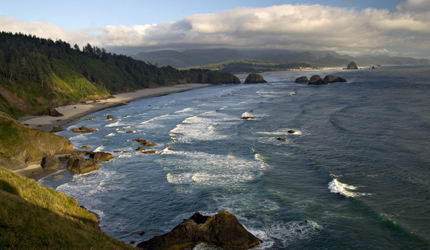
 Marine Reserves Bill Dies
Despite countless hours of local and regional public input all up and down the Oregon Coast on whether and where to establish marine reserves for scientific studies leading to a better understanding of Oregon’s territorial waters, the crescendo that was building toward a new law formally establishing such reserves fell flat in the waning days of the Oregon Legislature. It didn’t happen. As with any legislative success there are many fathers and mothers, but for failed bills, they’re all orphans.
Local and regional environmental groups, citing a long Oregon history of interest in understanding the scientific baselines for coastal waters saw the opportunity in HB 2009 to provide that structure with carefully delineated marine reserves that in some cases allowed some commercial and sport fishing, while others did not. Scientists and their supporting environmental agencies and organizations have claimed that ocean resource managers will be equipped to make better decisions if regulators more fully understand what are ambient ocean conditions and which ones aren’t.
All through the various hearings from Brookings to Astoria, and in Salem and Portland, various groups, afraid that their access to ocean resources would be reduced or otherwise marginalized, opposed the the very concept of marine reserves for a number of reasons. They contend that marking off specific offshore areas is an arbitrary act of human beings who unjustifiably declare that a given area is “pristine” or somehow less affected by human activity or global ocean dynamics. They describe the ocean as a huge system, all connected together that appears, at times, to defy smaller scale scientific theories that seek to explain ocean trends in terms of water conditions, fish and mammal habitat and other factors.
However, environmental groups, which have a big political fist in Oregon politics and who side with those who want marine reserves established, claim that humans are ravaging the oceans with overfishing and excessive pollution among other assaults on ocean health. And they say they have scientific proof. It was often said at coastal meetings conducted by the Ocean Policy Advisory Council, which is advisory to the Governor and the Legislature on coastal matters, that if the legislature failed to establish marine reserves, environmental groups would launch armies of voter signature gatherers and put the issue on the ballot – and that it would pass overwhelmingly; lose in the rurals but be enormously popular in the Portland and Eugene metro areas, which of course, would carry the state.
But if there remains any doubt that HB 2009 is dead, it would have to be due to direct intervention by Governor John Kitzhaber who, while governor years ago, first pioneered the idea of marine reserves and pushed hard to have them established. Just because the legislature failed to enact a marine reserves law doesn’t mean that’s the final word. Kitzhaber reportedly could sign executive orders requiring the activation of such activities funded by money already socked away in a number of Oregon environmental agencies like parks, wildlife and fisheries. Those considered “moderates” on marine reserves would more likely prefer such an approach rather than a more restrictive version that would evolve from a statewide initiative.
So now the wait begins to see who blinks first.
Environmentalists have been threatening to file a ballot initiative for more than 10 years. If they think they can make money or expand their influence by doing it, they will. Coastal communities sacrificing one fishing area after another makes no difference to them.
As for this article, I wouldn’t characterize anti marine reserves reasons as you have. Advocacy for reserves hasn’t ever made a point with which they can prevail.
“However, environmental groups, which have a big political fist in Oregon politics and who side with those who want marine reserves established, claim that humans are ravaging the oceans with overfishing and excessive pollution among other assaults on ocean health. And they say they have scientific proof.” Is how you wrote it.
It’s correct in that they’ve been saying these things. And yet they’ve had more than 10 years to bring any proof, or to cite a relevant argument, and they’ve brought nothing except their threats to play mean.
They’ve not identified a single problem in the territorial sea that marine reserves would address, none that aren’t shot down by multiple reasons. Oregon doesn’t have money for this nonsense. It has, instead, decided that out of state environmental groups can finance it if they want. They did in California, and made a big mess of it all.
The sentence reads, “They say they have proof.” I wasn’t taking sides.